Why a Simple Email Funnel Is Your Best Business Tool
If you run an online business, a simple email funnel is one of the fastest ways to turn casual visitors into paying customers — without guessing or shouting into the void. And creating even a simple email funnel is crutial for your business. A well-crafted funnel does the heavy lifting: it captures interest, builds trust, and nudges people toward a clear next step (usually a purchase or sign-up).
You don’t need complicated sequences, expensive tools, or a massive audience. A simple, strategic email funnel—done right—can drive consistent sales, increase lifetime value, and free up your time using automation.
In this guide you’ll learn:
- What an email funnel is and why it matters
- The three essential funnel stages (TOF → MOF → BOF)
- How to create a lead magnet that converts
- How to write a short, high-performing welcome sequence
- How to automate and measure results so you can scale
This post is practical and tactical — ready for beginner implementation. Let’s build a funnel that actually makes money.
What Is an Email Funnel & Why It Matters
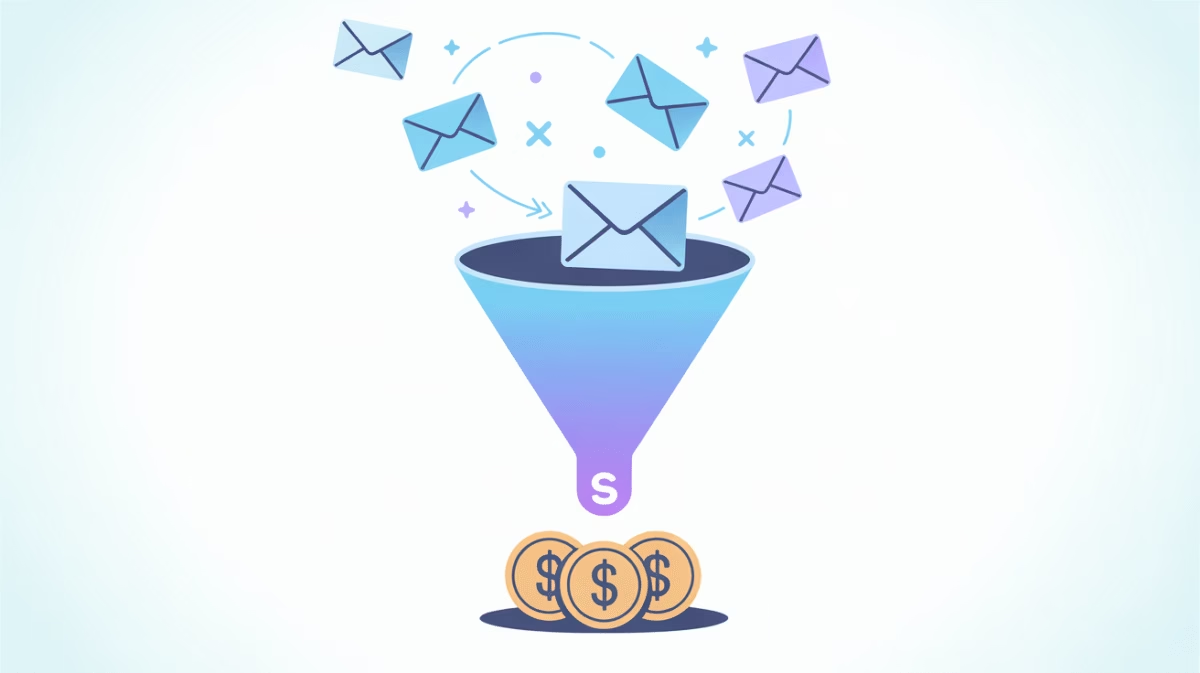
An email funnel is a planned sequence of emails designed to guide people from discovery to purchase. Think of it as a customer journey map expressed through emails: each message has a purpose and nudges the reader a little further toward your goal.
Simple Email funnel flow:
- Top of Funnel (TOF) — Attract & capture (lead magnet + opt-in)
- Middle of Funnel (MOF) — Build trust & deliver value (welcome series + education)
- Bottom of Funnel (BOF) — Convert (offer, testimonials, urgency)
Why funnels outperform random email blasts
- They move people through a logical journey, not one-off pushes.
- Funnels automate follow-ups so you don’t miss opportunities.
- Funnels personalize messaging based on where subscribers are in the journey.
- Funnels let you measure and optimize each stage for better ROI.
Quick real-world Email funnel example
A blogger offers a “5-day content calendar” (TOF). The welcome sequence (MOF) delivers the calendar, shares quick tips, and shows a case study. On day 7, a BOF email introduces a paid mini-course with an early-bird discount. That sequence converts because it’s helpful, timed, and relevant.
The 3 Stages of a Simple Email Funnel (What to Send & When)
Understanding the three stages simplifies funnel building. Below is exactly what to focus on at each stage and the short, effective content you should send.
Top of Funnel (TOF): Attract & Capture
Goal: Turn a visitor into a subscriber.
What to use:
- Lead magnet — checklist, template, mini-guide, or discount.
- Landing page — single goal: collect email.
- Opt-in forms — within blog posts, pop-ups, sidebar, or social bio.
Why it works: People trade their email for immediate, useful value. Your lead magnet should solve one clear problem and connect to your paid offer later.
Quick TOF checklist:
- Clear headline that states the benefit
- One-sentence value proposition
- Minimal form fields (email or email + first name)
- Visible CTA that promises the instant win
Middle of Funnel (MOF): Build Trust & Deliver Value
Goal: Nurture the relationship so subscribers know, like, and trust you.
What to send:
- Welcome email(s) — deliver the lead magnet and set expectations.
- Value emails — tutorials, quick wins, case studies, and helpful stories.
- Social proof — testimonials, results, or mini-case studies.
Structure a simple MOF flow (3 emails):
- Email 1 – Deliver + Welcome: Thank them, deliver the lead magnet, brief intro.
- Email 2 – Value: Quick actionable tip related to the lead magnet.
- Email 3 – Social proof + soft pitch: Story + subtle intro to your product/offer.
Why it works: You build credibility step-by-step so the BOF ask feels natural — not forced.
Bottom of Funnel (BOF): Convert
Goal: Present a clear offer and help the subscriber take action.
What to send:
- Offer email — concise pitch, benefits, price, and CTA.
- Reminder/follow-up — limited-time bonus or urgency element.
- FAQ or objection-handling — short answers to common doubts.
Best BOF practices:
- Keep the offer simple (low friction for beginners)
- Use clear benefits (what they gain, not features)
- Add social proof near your CTA
- Include a clear deadline or limited bonus to increase urgency
Mini Example Funnel (3–5 Emails)
- Landing page opt-in → deliver checklist
- Welcome — deliver checklist + short story
- Value — how to use checklist to get fast wins
- Offer — low-cost course/ebook with testimonial
- Follow-up — last chance + FAQ
This short funnel can run on autopilot and bring repeatable sales.
Step 1 — Create a Compelling Lead Magnet (The First Yes)
Your lead magnet is the entry point of your email funnel. It must be so helpful and relevant that your ideal audience eagerly trades their email to get it.
✔ What Makes a High-Converting Lead Magnet
A great lead magnet should be:
- Specific — solves one clear problem
- Fast to consume — short wins convert better than long ebooks
- Aligned with a paid offer — leads into your product or service
- Visually clean + easy to access
🧲 Best-performing formats for beginners:
- Checklists (ex: “10 Steps to Launch Your Etsy Shop”)
- Templates (ex: social media captions, funnel map)
- Mini video training (5–10 minutes)
- Discount code (for ecommerce)
- Cheatsheet / Quick guide
📌 Example for a fitness coach:
Lead magnet → “7 Fat-Burning Breakfast Recipes”
Paid offer → Meal plan or nutrition coaching
Perfect alignment.
✔ Where to Promote Your Lead Magnet
Place opt-ins where your audience already pays attention:
- Homepage hero section
- Blog posts (inline + end-of-post CTAs)
- Pop-ups and slide-ins
- Social media profiles (“link in bio”)
- Relevant YouTube video descriptions
🧠 PRO TIP:
Create one lead magnet per audience segment so personalization starts from day one.
🧠 Want help creating your first freebie?
Read: How to Create a High-Converting Lead Magnet for Email Growth?
Step 2 — Build a Landing Page That Converts (No Distractions!)
Your landing page has one job: get the opt-in.
People should instantly understand what they’re getting and why it matters.
✔ Must-Have Elements of a High-Converting Landing Page
1️⃣ Clear headline that promises a result
Example: “Steal my 3-step funnel that turns followers into customers”
2️⃣ Benefit bullets
- What will they achieve?
- How will they feel after getting it?
- What mistake will they avoid?
3️⃣ Strong visual
- Mockup or preview of the lead magnet
4️⃣ Short form
- Only ask for the email (or first name + email)
5️⃣ Clear CTA
Example: “Send me the checklist!”
6️⃣ Trust elements
- Short testimonial
- Small credibility badge if available
✔ Copy Formula You Can Copy
Headline:
“One Simple Resource to Help You _______ (Desired Result)”
Sub-text:
“Get this free _______ and learn _______ so you can _______ without _______.”
CTA Line:
“Yes! I Want Instant Access”
✔ Mobile Optimization Checklist
- CTA visible without scrolling
- Large text + clean spacing
- No pop-ups covering CTA
- Load in under 2 seconds
📈 Mobile-friendly pages convert 30–50% better for most beginners.
Step 5 — The Soft Pitch Email
⏰ Send: 5–7 days after signup
🎯 Goal: Introduce your offer without sounding pushy
📌 What this email includes:
- Light mention of your paid product/service
- The reason you created it (your story + audience pain point)
- A small value nugget they can use immediately
- Low-pressure CTA (“If you’d like help with ___, check this out”)
📨 Example Subject Lines:
- “The exact system I use to ___”
- “Want faster results without guesswork?”
- “Here’s how I can help you achieve ___”
CTA Example:
👉 Take a look at the full program here
✔ Tip: Focus on how life becomes better with your solution — not the features.
Step 6 — The Strong Pitch Email
⏰ Send: 1–2 days after the soft pitch
🎯 Goal: Clearly present the offer and why action matters
📌 What this email includes:
- What the product is
- Who it is for
- What problem it solves
- Social proof if you have any (reviews, results, quotes)
- A strong, clear CTA
📨 Example Subject Lines:
- “Ready to achieve ___?”
- “Last chance before the bonus expires”
- “This could change your ___”
✔ Tip: Add urgency only if it’s real. Teensy pressure = okay. Fake scarcity = 👎
Step 7 — The Follow-Up / Objection Crusher
⏰ Send: 24 hours after the strong pitch
🎯 Goal: Address doubts + reinforce benefits
📌 Common objections to handle:
- “I don’t have time”
- “I’m not sure it’ll work for me”
- “Money is tight”
How to respond:
→ Give examples of people like them who succeeded
→ Remind them of what inaction costs
→ Offer a guarantee (if applicable)
📨 Example Subject Lines:
- “Still thinking about it?”
- “Quick question…”
- “This might help you decide”
✔ Tip: Keep tone supportive, not salesy.
Step 8 — Long-Term Nurture
⏰ Weekly or bi-weekly
🎯 Goal: Keep audience engaged + build trust for future sales
Content Mix (rotate weekly):
| Content Type | What You Send |
|---|---|
| Value-First Lessons | Simple tutorials, templates, case studies |
| Personal Story Emails | Behind-the-scenes, real struggles, funny fails |
| Mini Soft Pitches | Remind them your offer exists |
| Survey Emails | Ask what they need help with |
✔ The more consistent you are, the more sales you’ll make over time.
🎯 Funnel Summary (at a glance)
| Email # | Type | Timing | Goal |
|---|---|---|---|
| 1 | Delivery | Immediately | Give lead magnet + warm welcome |
| 2 | Value | Day 2 | Prove expertise + easy win |
| 3 | Trust-Building Story | Day 3–4 | Emotion + relatability |
| 4 | Engagement | Day 4–5 | Interaction + segmentation |
| 5 | Soft Pitch | Day 5–7 | Introduce offer |
| 6 | Strong Pitch | Next day | Encourage purchasing |
| 7 | Objection Crusher | Next day | Reduce hesitation |
| 8+ | Ongoing Nurture | Weekly | Long-term revenue |
🔥 Conversion-Boosting Enhancements
| Trigger | What It Does | Example |
|---|---|---|
| Behavioral Automation | Sends emails based on actions | If they clicked but didn’t buy → bonus reminder |
| Personalization | Makes emails feel 1:1 | Use name + segment interest tags |
| Social Proof | Builds credibility | Success stories, before/after |
| Scarcity (Real Only) | Drives action | “Bonus ends Friday” |
📌 Metrics That Tell You Your Funnel Is Working
- 30–45% Email open rate
- 5–15% Click-through rate
- 1–5% Conversion rate
If numbers are low → adjust subject lines & value flow.
✨ Conclusion — Keep It Simple, Start Today
You don’t need a huge audience, fancy tech, or months of planning.
A simple email funnel can:
✔ Turn strangers into fans
✔ Turn fans into loyal customers
✔ Generate sales even when you’re offline
Your first funnel won’t be perfect — and it doesn’t need to be.
Start with one good lead magnet + this simple 7-email sequence.
📌 The businesses that grow are the ones that start.
👉 If you’d like, I can help you:
- Write each of the emails
- Set up automation in Mailchimp, ConvertKit, or any tool you use
- Create lead magnets that get tons of signups
Just tell me on my contact page!
Do you already have a lead magnet? And what are you selling?
(Or if you need ideas, I can suggest some!)
Ready when you are! 🚀