
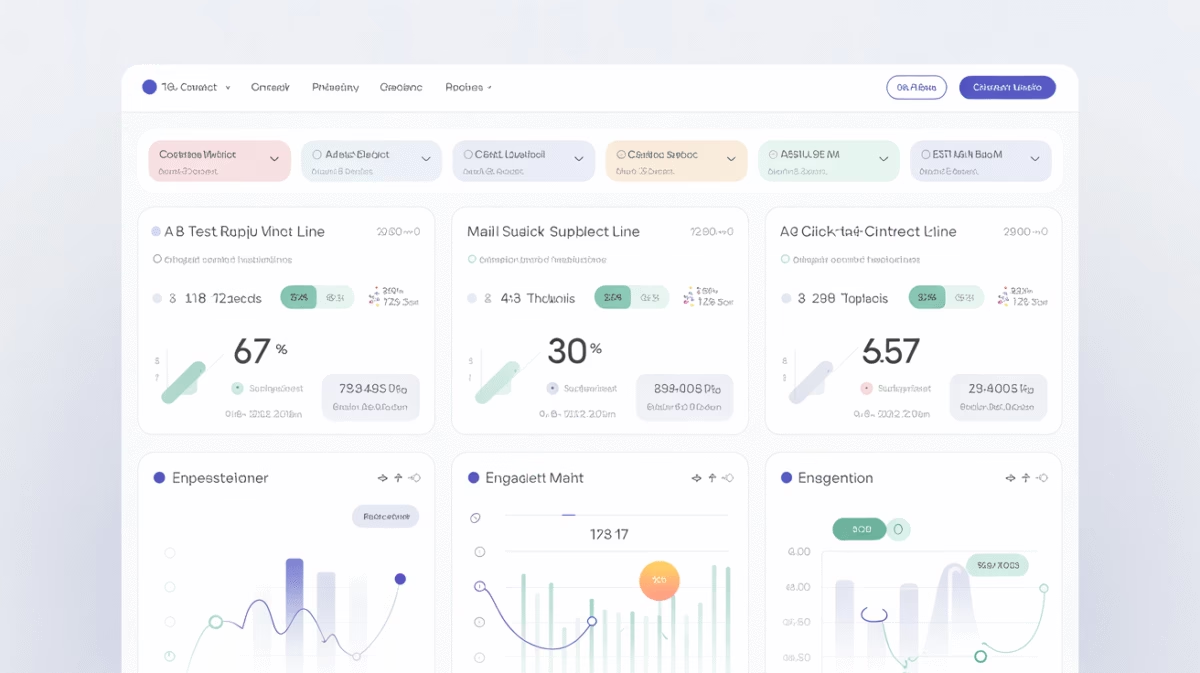
Introduction: Why A/B Testing in Email Marketing Is a Game-Changer
A/B Testing in Email Marketing Is a Game-Changer, if you’re sending emails without A/B testing, you’re essentially guessing what your audience wants. And in digital marketing, guessing costs you opens, clicks, and sales.
A/B testing (also called split testing) removes the guesswork. It shows you—based on real data—exactly what makes your subscribers open more emails, click more links, and take more action. Even the smallest changes, like switching a word in your subject line or moving your CTA button, can dramatically improve your results.
This guide will walk you step-by-step through what to test, how to run proper A/B tests, and how to use the results to improve every email you send. By the end, you’ll know how to boost engagement, increase conversions, and build a smarter email strategy that grows with your business.
1. What Is A/B Testing in Email Marketing? (Simple Explanation)
A/B testing in email marketing means sending two different versions of an email to segments of your audience to see which one performs better.
- Version A = your original email (the “control”)
- Version B = a slightly changed version (the “variation”)
Your email platform will send both versions, track the performance, compare the numbers, and show you which one won.
Example
You want to know which subject line gets more opens:
- A: “Your Weekly Deals Are Here”
- B: “🔥 New Deals Just Dropped — Don’t Miss Out”
Your platform sends A to 50% of subscribers and B to the other 50%.
Whichever earns a higher open rate is the winner.
Why this matters
Because what you think sounds good isn’t always what your audience responds to. A/B testing allows your subscribers—not your assumptions—to shape your strategy.
2. Why A/B Testing Is Essential for Email Marketing Success
Most online businesses plateau because they send emails based on instinct instead of evidence. A/B testing stops that from happening and gives you a measurable path to improvement.
Here’s why it’s essential:
1. It Dramatically Improves Your Email Performance
Want higher open rates?
More clicks?
More sales?
A/B testing is the fastest, most reliable way to boost all three.
Small tweaks often lead to big jumps—especially in subject lines and CTAs.
2. It Helps You Understand Your Audience Better
Every test gives you new insight:
- Do your subscribers prefer short or long emails?
- Do they click image-based CTAs or text links?
- Do they open emails in the morning or late at night?
The more tests you run, the smarter your email strategy becomes.
3. It Prevents Performance From Declining Over Time
Subscriber behavior changes.
Markets change.
Inbox competition increases.
Without testing, your performance can silently decline.
With A/B testing, you catch issues early and adjust.
4. It Works for All Niches and Business Models
A/B testing is universal:
- Coaches
- Bloggers
- SaaS
- Ecommerce
- Affiliate marketers
- Local businesses
No matter what you sell, testing helps you send emails people actually respond to.
5. It Leads to Higher Revenue — Automatically
Every improvement you make multiplies over time:
Higher open rate → more clicks
More clicks → more conversions
More conversions → more revenue
A/B testing builds a compound-growth engine into your email marketing.
3. What You Should A/B Test (The Core Elements That Actually Move the Needle)
Most beginners think A/B testing means changing random things.
But smart marketers focus on testing the elements that have the biggest impact on open rates, CTR, and conversions.
Below are the most important areas to test—each one can significantly improve your email results.
3.1 Subject Lines (The #1 Factor for Open Rates)
Your subject line determines whether someone opens your email or ignores it.
A/B testing here often produces the biggest lift.
Test ideas:
- Short vs long
- Curiosity-driven vs benefit-driven
- Personalization (“Hey John” vs no name)
- Numbers vs no numbers
- Emojis vs no emojis
- Urgency vs calm tone
Example test:
A: “3 tools that will save you time this week”
B: “Save 4+ hours this week with these tools”
Why it matters:
Even a 2% increase in open rates can mean hundreds more readers—every week.
3.2 Preheader Text (Your “Second Headline” in the Inbox)
Your preheader is the preview text under the subject line.
Most people don’t optimize it—big mistake.
Test ideas:
- Adding clarity
- Adding urgency
- Adding a bonus benefit
- Highlighting a pain point
- Asking a question
Example:
A: “Tools that save time—see what’s new”
B: “Cut your workload in half—starting today”
3.3 Email Content & Length
Not all audiences prefer the same email style.
Some want short “just the value.”
Others enjoy storytelling.
Test ideas:
- Short vs long email
- Story format vs bullet format
- Text-only vs image-supported
- Value-first vs CTA-first
Example test:
A: Short email with 1 CTA
B: Longer email with story + 2 CTAs
3.4 CTA (Call-to-Action) Button or Link
Your CTA is where conversions happen.
A small tweak can completely change click-through rates.
Test ideas:
- Button vs text link
- “Learn More” vs “Get Instant Access”
- CTA at top vs CTA at bottom
- Contrasting colors vs subtle colors
Example test:
A: CTA: “Download the Guide”
B: CTA: “Get Your Free Guide Now”
3.5 Send Times & Send Frequency
Timing plays a huge role in engagement.
Test ideas:
- Weekday vs weekend
- Morning vs afternoon vs evening
- 1 email/week vs 2 emails/week
- Based on subscriber time zone
Why these tests matter:
Finding the right send time can increase opens without changing anything else.
3.6 Sender Name (From Name)
Changing “from name” can shockingly improve open rates.
Test options:
- First name only (“Bruno”)
- First name + brand (“Bruno from OBFL”)
- Brand only (“Online Business For Living”)
Some audiences trust personal names more.
Others prefer brands.
You’ll only know by testing.
✔ 3.7 Visual Elements (Design That Influences Clicks)
Depending on your audience, visuals can help—or distract.
Test ideas:
- Plain text vs designed template
- Hero image vs no hero image
- Product images vs text description
- Smaller vs larger images
3.8 Personalization Elements
Adding personalization often lifts results—but not always.
That’s why testing matters.
Test ideas:
- Using subscriber name
- Personalized product or content recommendations
- Dynamic locations
- Previous behavior (example: “You left this behind…”)
4. How to Start A/B Testing (A Simple, Beginner-Friendly Process)
A/B testing becomes powerful when you follow a structured process.
Here’s the exact workflow smart marketers use.
Step 1: Choose ONE Variable to Test
Don’t test too many things.
To get accurate results, isolate a single change.
Bad test:
Changing subject line + CTA + email content
(You won’t know what caused the improvement.)
Good test:
Changing only the subject line.
Step 2: Define Your Success Metric
Your test must have a clear goal.
Common metrics:
- Open rate → for subject line + preheader tests
- Click-through rate (CTR) → for CTA + email content tests
- Conversion rate → for landing page-related tests
- Reply rate → for relationship-building emails
Be specific:
“I want to increase CTR by at least 15%.”
Step 3: Split Your Audience
Your email platform splits your list automatically.
Two common methods:
1. 50/50 split (best for accuracy)
Half get Version A.
Half get Version B.
2. Small test → send winner to rest
Perfect for large lists.
Example:
10% get A, 10% get B → winner goes to remaining 80%.
Step 4: Create the Two Versions
Make sure the versions differ in one clear way.
Good example:
A changes CTA color.
B keeps everything else exactly the same.
Step 5: Run the Test Long Enough
Many beginners check too early.
Let the test run 24–48 hours minimum.
Why?
People open emails at different times.
Step 6: Analyze the Results
Compare:
- Open rates
- CTR
- Unsubscribes
- Bounce rate
- Conversion rate
Don’t just look at who “won.”
Look for why it won.
Step 7: Apply the Winner + Document It
Every test creates a new insight.
Record:
- What you tested
- The result
- What you learned
Over time, you build a “winning formula” for your emails.
5. Best Practices for Reliable A/B Tests (Avoid These Common Pitfalls)
A/B testing works beautifully—if you avoid the mistakes most beginners make.
Here are the best practices to keep your tests accurate and meaningful.
Test One Variable at a Time
This is the golden rule.
If you test multiple things, you won’t know what caused the outcome.
Keep Your Sample Size Meaningful
Testing 20 people tells you nothing.
Aim for at least 200–500 subscribers per variation for useful insights.
(If the list is small, run tests over time and look for patterns.)
Avoid Testing During Unusual Events
Don’t test during:
- Black Friday
- Holiday weeks
- national events
- Major news cycles
People behave differently during these periods.
Repeat Winning Tests to Confirm the Pattern
One test does not guarantee long-term success.
Test again → see if the result holds.
Don’t Chase Vanity Metrics
High open rates are great…
But CTR and conversions matter more.
A subject line might get tons of opens—but zero clicks.
Always focus on metrics tied to business outcomes.
Track How Tests Work Across Segments
Some segments react differently.
Example:
Your EU readers may prefer morning emails.
Your US readers may prefer evenings.
Segment-level testing = better personalization + better performance.
6. Mobile Optimization: Ensuring Your Emails Perform on Every Device
Over 70% of people open emails on mobile, which means even a perfectly crafted message can flop if it isn’t mobile-friendly. A/B testing for mobile optimization helps you eliminate friction, improve readability, and increase clicks.
6.1 Test Mobile-Friendly Subject Lines
Shorter subject lines generally perform better on small screens.
Try testing:
- 30–45 character subject lines
- Removing unnecessary punctuation
- Simplifying benefit statements
Goal: Improve visibility and avoid truncation.
6.2 Test Layout Structure
Mobile screens favor clean layouts.
Elements to A/B test:
- Single-column vs multi-column designs
- Large vs normal line spacing
- More vs fewer images
- Templates vs text-only
Pro Tip: Text-only emails often win on mobile because they feel personal and load faster.
6.3 Test CTA Placement for Thumbs
Your CTA should be “thumb-reachable.”
Test:
- CTA at the top of the email
- CTA after the main body
- Sticky/fixed CTA (for some builders)
6.4 Test Font Size and Button Size
Small text or tiny buttons kill clicks.
Test:
- Larger body text (16–18px)
- Larger buttons (minimum height 44px)
- Bold headlines vs regular weight
6.5 Test Image Compression
Slow-loading images cause drop-offs.
Test:
- Heavy vs compressed images
- Full-width visuals vs small visuals
- Emails with zero images
Sometimes the simplest email wins.
7. Deliverability Testing: Make Sure Your Emails Actually Reach Inboxes
Even the best A/B test is useless if your emails land in spam. Deliverability testing ensures your message reaches the inbox, not the junk folder.
7.1 Test Sending Domains
Some brands get higher deliverability from alternate domains or subdomains.
Test:
- mainbrand.com
- mail.mainbrand.com
- newsletter.mainbrand.com
7.2 Test Authentication Improvements
Authenticated domains improve inbox placement.
Test impact of adding:
- SPF
- DKIM
- DMARC
Simple A/B:
Enable DKIM, send identical campaigns → measure inbox rate.
7.3 Test Sending Frequency
Too many emails = spam complaints. Too few = cold list.
A/B test:
- 1 email/week vs 2 emails/week
- Weekly vs biweekly
- Frequency changes during promotional campaigns
7.4 Test Segmentation for Better Engagement
Low-engagement users drag down deliverability.
Test:
- Sending to full list vs engaged segment
- Re-engagement campaign vs silent removal
- High-intent segments vs broad audience
7.5 Test Clean List Practices
A/B test list hygiene routines:
- Removing inactive subscribers
- Soft bounce retries vs immediate removal
- Confirmed opt-in vs single opt-in
Result: Higher deliverability, fewer spam traps, stronger inbox placement.
Conclusion (Optimized, High-Converting)
A/B testing is the single most reliable method to improve your email marketing performance — not by guessing, but by learning exactly what your audience responds to. Every test gives you data, every insight compounds, and every win builds a more effective, higher-converting email system.
Start simple: test one variable, use clear goals, measure the right metric, and document your results. Then expand into advanced testing — segmentation, mobile optimization, deliverability, and personalization.
Over time, you’ll build an email marketing engine where nothing is random, everything is optimized, and your results keep growing month after month. A/B testing turns your emails into a predictable, scalable revenue channel — one experiment at a time.
✅ Key Takeaways (Condensed & Optimized)
- A/B testing removes guesswork by showing exactly what your audience responds to.
- Test only one variable at a time for accurate insights.
- Prioritize high-impact tests first: subject lines, CTAs, layout, personalization.
- Use statistical significance to ensure your results are valid.
- Test content, design, timing, and send frequency to boost engagement.
- Optimize for mobile, where most opens occur.
- Improve deliverability with authentication, segmentation, and clean lists.
- Document your tests to build a predictable, scalable email strategy.
For more guidance, check out: