
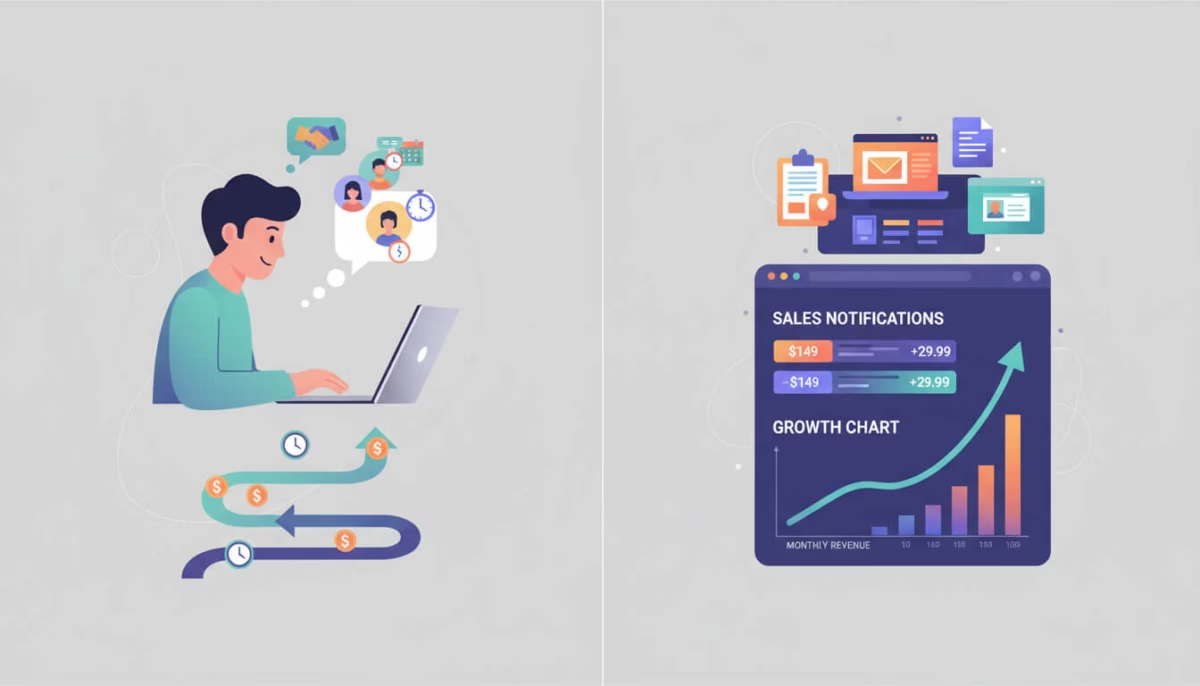
Introduction: Service-Based vs Product-Based Online Businesses — The Real Difference (And Why It Matters)
If you search online for “service-based vs product-based online businesses”, you’ll find a lot of vague advice.
Some people say:
“Services are easier.”
Others say:
“Products are better because they’re passive.”
Both statements are incomplete — and that’s exactly why beginners get confused, stuck, or worse… start the wrong business for their situation.
Here’s the truth most articles don’t clearly explain:
👉 Service-based and product-based online businesses solve different problems at different stages of your journey.
Choosing the wrong one doesn’t just slow you down — it can:
- delay income by months or years
- destroy motivation
- make you think “online business doesn’t work”
As someone who has studied hundreds of online business case studies, freelancers, creators, and digital entrepreneurs, I can tell you this with confidence:
The question is not “Which is better?”
The real question is “Which is better for YOU right now?”
In this guide, I’ll break down service-based vs product-based online businesses in a way that is:
- clear
- practical
- beginner-safe
- and brutally honest
By the end of this article, you’ll know:
- exactly how each model works
- which one fits your skills, budget, and timeline
- why most successful people don’t choose only one
- and what smart beginners should start with (and why)
If you’re serious about building an online business that actually works, read this carefully until the end — it will save you months of trial and error.
1. What Is a Service-Based Online Business? (Clear, Practical Definition)
A service-based online business is one where you make money by providing a service directly to clients.
You are paid for:
- your time
- your skills
- your expertise
- or a specific result you deliver
This is the most straightforward and proven way to make money online — especially at the beginning.
Real-world examples of service-based online businesses
Service-based online businesses include:
- freelancing (writing, design, development, VA, marketing)
- consulting
- online coaching
- agencies
- done-for-you services
Examples:
- a freelance copywriter charging $500 per project
- a social media manager charging $800/month per client
- an agency managing websites or ads for businesses
In every case, the value exchange is clear:
You solve a problem → the client pays you.
Why service-based online businesses are so common (and trusted)
There’s a reason most successful online entrepreneurs start with services.
Service-based businesses:
- don’t require an audience
- don’t require traffic
- don’t require brand authority
You don’t need people to “discover” you.
You only need:
- one person with a problem
- and the ability to solve it better than they can
That’s why this model is highly trusted and validated — clients only pay if they believe the value is real.
Proof this model works (logic, not hype)
Service businesses dominate online marketplaces for a reason.
Platforms like:
- Upwork
- Fiverr
- Freelancer
process millions of dollars every day in service-based transactions.
That’s not theory.
That’s demand.
The biggest advantage of service-based online businesses
The #1 advantage is speed to income.
If you need money:
- this month
- not “someday”
a service-based business gives you the fastest path from zero to paid.
This is why experienced entrepreneurs often say:
“If I had to start over with nothing, I’d sell a service first.”
2. What Is a Product-Based Online Business? (And Why It Feels So Attractive)
A product-based online business is one where you sell something that exists independently of your time.
Once the product is created, it can be sold:
- repeatedly
- globally
- without direct involvement for every sale
This is where ideas like scalability and leverage come in.
Common types of product-based online businesses
Product-based online businesses include:
- digital products (ebooks, templates, courses)
- software & SaaS
- memberships
- physical or print-on-demand products
Examples:
- a $29 ebook sold worldwide
- an online course hosted on a learning platform
- a Shopify store selling products
- a subscription-based tool or community
Here, the value exchange looks different:
You create once → sell many times.
Why product-based online businesses are so appealing
Let’s be honest — product-based businesses sound amazing.
People are drawn to them because they promise:
- scalability
- automation
- location freedom
- less direct client work
And yes — those benefits are real.
Many of the biggest online success stories are product-based:
- courses
- software
- digital tools
- platforms
But here’s the part most people don’t explain clearly
Product-based businesses are harder to start, especially for beginners.
Why?
Because before people buy products, they need:
- trust
- awareness
- proof
And those things usually come from:
- an audience
- content
- or prior credibility
This is why many beginners build a product first… and then struggle to sell it.
Not because the product is bad — but because no one knows or trusts them yet.
The real strength of product-based online businesses
Product-based businesses shine in the long term.
They are ideal if:
- you want leverage
- you want freedom from hourly work
- you want to build assets that compound
But they reward:
- patience
- consistency
- marketing skill
This is not a flaw — it’s simply the nature of the model.
Why this comparison matters (keep reading)
At this point, you can already see something important:
- service-based businesses win on speed and simplicity
- product-based businesses win on scale and leverage
In the next sections, I’ll:
- compare them side by side
- explain which one is better at each stage of growth
- show why most successful online businesses combine both
👉 This is where the real clarity happens — and where most articles stop short.
3. Service-Based vs Product-Based Online Businesses: Key Differences Explained Clearly
Let’s remove all confusion and compare service-based vs product-based online businesses at the level that actually matters: execution, risk, income behavior, and growth reality.
Most articles stop at surface-level differences. That’s not helpful.
Here’s what really separates them.
1. How money is earned (core difference)
In a service-based online business, money is earned when:
- you deliver work
- you invest time
- you apply skill directly
No delivery = no payment.
In a product-based online business, money is earned when:
- someone buys the product
- regardless of your time at that moment
Delivery is automated.
This single difference explains everything else — income speed, scalability, stress, and freedom.
2. Risk level at the beginning
This is where beginners often make costly mistakes.
Service-based businesses
- low financial risk
- almost zero upfront cost
- fast validation
If no one buys, you can pivot immediately.
Product-based businesses
- higher upfront effort
- delayed feedback
- risk of building something nobody wants
This is not theory — it’s pattern-based reality observed across thousands of failed and successful launches.
👉 From a risk perspective alone, service-based online businesses are safer for beginners.
3. Skill vs market dependency
- Service-based businesses depend primarily on your skills
- Product-based businesses depend primarily on the market and distribution
That’s why:
- a skilled freelancer can earn without an audience
- a great product can fail without traffic
This difference is critical — and often misunderstood.
4. Which Model Makes Money Faster (And Why Speed Matters)
When people ask “Which is better?”, what they often mean is:
“Which one will make money faster?”
Let’s answer that honestly.
Service-based online businesses make money faster — here’s why
Service-based businesses win on speed because:
- clients already have problems
- they are actively looking for solutions
- they are used to paying for services
You don’t need to educate the market.
You simply position yourself as a solution.
That’s why:
- freelancers can get paid within weeks
- consultants can close clients quickly
- agencies can land retainers early
This is not possible with most product-based models.
Product-based online businesses are slower — but intentional
Product-based businesses take longer because:
- people must trust you
- people must understand the product
- people must see proof
Even excellent products usually require:
- content
- marketing
- audience building
This is why many successful product businesses are built by people who:
- previously freelanced
- coached
- consulted
They didn’t start from zero trust.
👉 Speed matters because early income buys time, confidence, and learning.
That’s why experienced entrepreneurs rarely recommend products as a first move.
5. Scalability, Freedom, and Long-Term Growth Potential
Now let’s talk about the part that products clearly win — long-term leverage.
Why service-based online businesses hit a ceiling
In a service-based model:
- more income usually requires more work
- your time becomes the bottleneck
To scale, you must:
- raise prices
- delegate
- or build systems (agency model)
This is achievable — but it requires management, not just skill.
Why product-based online businesses scale more easily
Product-based businesses scale because:
- delivery is automated
- one product can serve unlimited customers
- systems replace labor
This is why:
- courses
- software
- memberships
- digital products
can grow exponentially once they work.
However — and this is critical — scalability only matters after validation.
A scalable business with no buyers is still zero.
The expert perspective (this is important)
After analyzing countless online business paths, a clear pattern emerges:
Service-based businesses win early.
Product-based businesses win later.
The most resilient online entrepreneurs:
- start with services
- build skills, cash flow, and trust
- convert that trust into products
- scale with leverage
This is not opinion.
This is observable reality.
6. Which Model Is Better for Beginners? (The Honest, Experience-Based Answer)
If you’re at the beginning and asking “service-based vs product-based online businesses — which is better for beginners?”, here is the most honest answer you’ll find:
👉 Service-based online businesses are objectively better for beginners in 90% of cases.
This isn’t hype. It’s logic + evidence.
Why beginners struggle with product-based businesses
Most beginners fail with products because they lack:
- an audience
- trust
- marketing experience
- cash flow to wait months
They build:
- a course
- an ebook
- a store
…and then ask, “Why isn’t anyone buying?”
The problem isn’t effort.
The problem is starting with leverage before validation.
Why service-based businesses protect beginners
Service-based online businesses:
- create immediate feedback
- force real-world problem-solving
- generate income quickly
You learn:
- how people think
- what they actually pay for
- what language converts
This knowledge is priceless — and cannot be learned from theory.
That’s why professionals almost always recommend:
“Sell services first. Learn the market. Then build products.”
7. When (and How) to Transition From Services to Products
Here’s where most articles completely fail — they don’t explain timing.
The goal is not to choose one model forever.
The goal is to progress intelligently.
Clear signs you’re ready to add products
You are ready to move from a service-based to a product-based online business when:
- clients ask the same questions repeatedly
- you deliver the same solution again and again
- your time is fully booked
- your process is proven
At this point, a product is not a gamble — it’s a packaged solution.
Smart transition paths (real examples)
- freelancer → sells templates or guides
- coach → sells a course or group program
- consultant → sells a framework or toolkit
- agency → sells systems or training
Notice something important:
👉 The product is built from real service experience, not guesses.
This dramatically increases success rates.
8. The Hybrid Model: Why the Best Online Businesses Use Both
Here’s the professional-level insight most beginners never hear:
The strongest online businesses are hybrids.
They combine:
- service-based income (cash flow, insight)
- product-based income (scale, leverage)
Why hybrids outperform single-model businesses
Hybrid businesses:
- are more stable
- survive market changes better
- give flexibility
Services:
- fund growth
- validate ideas
Products:
- multiply results
- reduce dependency on time
This is why many top online entrepreneurs:
- still offer services
- while selling products at scale
Not because they “have to” — but because it’s smart.
Where we are now (and why you should keep reading)
At this point, you understand:
- the real difference between service-based vs product-based online businesses
- why one is better early and the other later
- how professionals transition and combine both
What’s left is:nal Verdict: Service-Based vs Product-Based Online Businesses — Which Is Better?
After breaking everything down logically, practically, and honestly, here’s the conclusion most people avoid giving because it’s not flashy:
Service-based online businesses are better to start.
Product-based online businesses are better to scale.
That’s the real answer.
Not because one is “good” and the other is “bad”, but because they serve different purposes at different stages of your journey.
If you’re early:
- you need cash flow
- you need real market feedback
- you need confidence and momentum
Service-based online businesses give you all three fast.
If you’re more advanced:
- you want leverage
- you want freedom from hourly work
- you want systems that scale
Product-based online businesses deliver that over time.
This is why the people who succeed long-term almost never choose only one.
They sequence them.
The Smart Path (Used by Real, Successful Online Businesses)
Here’s the pattern that shows up again and again in real-world online businesses:
- Start with a service-based online business
- Freelancing
- Consulting
- Coaching
- Done-for-you services
- Learn the market
- What people actually pay for
- What problems repeat
- What language converts
- Turn proven solutions into products
- Templates
- Courses
- Toolkits
- Systems
- Scale with leverage
- Fewer hours
- Higher margins
- More freedom
This path minimizes risk and maximizes learning.
It’s not the fastest to brag about — but it’s the fastest to win.
Why This Approach Builds Trust (Not Just Income)
One last thing that matters more than money:
Credibility.
When your product is built from:
- real clients
- real problems
- real results
people trust it.
That trust:
- increases conversions
- reduces refunds
- builds long-term brand value
This is why service-first entrepreneurs often outperform “product-only” beginners — not because they’re smarter, but because they’re grounded in reality.
🔑 Key Takeaways (Read This Twice)
- Service-based online businesses are best for beginners because they are fast, low-risk, and skill-driven
- Product-based online businesses are best for long-term scale, leverage, and freedom
- Starting with products without validation is the #1 reason beginners fail
- Services teach you the market faster than any course or theory
- The strongest online businesses are hybrids, not one-model-only
- The question isn’t which is better — it’s which is better right now
The One-Sentence Answer (Bookmark This)
If you need income and clarity, start with services.
If you want scale and freedom, build products — after validation.
That’s it. No hype. No shortcuts. Just reality.
Next steps
Looking to further enhance your online business journey? Check out these valuable resources to help you navigate and excel in various aspects of building and growing your online presence:
- Essential Tools for Starting an Online Business – Discover the must-have tools to set up and grow your online business. Find out what you need to succeed!
- How to Start an Online Business from Scratch– A comprehensive guide for beginners to kickstart their online business journey. Get started on your path to success!
- Building Online Presence As A Freelancer: A comprehensive Guide – Tips and strategies to enhance your online presence as a freelancer. Elevate your freelance career now!
For more informations or some questions, feel free to contact me on my contact page. And if you want, you can subscribe to my email list for more content like this. However, you can unsubscribe at everytime.

